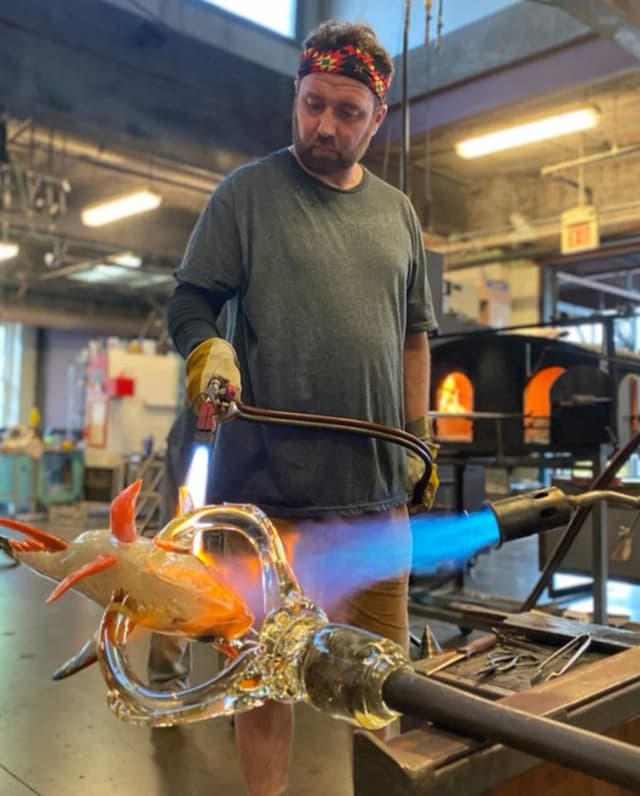
Artist Joshua Tracy talks fish, glass, and the countercurrents of life Interview by Katie Aiken Ritter The creature lies in your hands: angry, agitated, twisting, fearful and fierce and beautiful, a thing of sharp fins and smooth scales, a being which gleams when light pierces the underwater realm in which it lives—and now, still wet, shimmers under the sun. You pitted your muscles and will against those of the fish, your line and your hook and reel wresting it above the surface where it did not want to be. You hold it, victor, its life literally in your hands—and for a heartbeat in time, the two of you are irrevocably bound. Gaze at the astonishing colors that run from its mouth to its tail. Feel its sleek slipperiness, its strength. Peer at the perfect orb of its eye, seeing things it cannot begin to comprehend. You marvel at this being so different from you. One last look, and you set it free. It flashes, twists in the water, and is gone. It is this essence of vital aliveness which artist Joshua Tracy seeks to capture in his glass creations of fish: the pulsing of one’s senses, the heightened awareness of colors, the conflicting passions of capture and survival, of one creature being fed or the other being freed, and the sudden grace of release; a mysterious connection between two beings who have struggled together and will never meet again. Josh Tracy is a fisherman. He knows firsthand the wonder of catching a creature that inhales water, a thing that understands rain and ripples differently than he, a being that looks up to the same surface through which he peers down. Just as an angler must wrestle with rod and reel and tackle, and with shifting footing on sand or stone or the surface of a boat, Josh wrestles with fire and heat, with this stuff of molten sand called glass, with color, with air, with gravity, striving to capture in glass that indescribable moment in which you hold a living fish in your hands. If you are not an angler, you may not share his fascination with fin fish, but you will still find Josh’s works brilliant and beautiful. If you do fish, you will see how meticulously Josh has worked to bring to life the natural curve of swordfish versus that of a tarpon, or the markings of a rockfish, or the smooth beauty of a brook trout. Josh speaks the language of fluid wild things that you both treasure. Manor Mill Gallery is excited to host the first comprehensive show of Josh’s work in almost two decades, one that shows the result of dedication to his craft across that time. And what craft, exactly, is that? Is it glassblowing —or glass sculpture ? Not being a glass artist myself, I did not realize how very unusual Josh is. Glass artists for the most part are divided into those who blow hollow rounded wares—vases, bowls, cups, round ornaments, pumpkins—and those who work with glass as a sculptural material. Not blowing, as it were. Josh, it turns out, has a foot in both worlds. And while it is a highly unusual stance for a glass artist, perhaps it is not so surprising. Having a foot in two worlds forms a pattern that repeats again and again through Josh’s life. Here is one example of that pattern: being a skilled scholarship athlete on a Division One lacrosse team, who also yearned to become a professional artist. “My lacrosse teammates would make fun of me at study hall for working on a charcoal sketch of a nude from figure drawing class—and once the other arts students learned I was a varsity athlete, they would assume that I was just some dumb jock. I never felt at home or really accepted in either world.” The lacrosse scholarship at Ohio State University meant waking at 6 a.m. each day, running 5K miles, then doing nutrition, then working out with weights—all of that before classes, and or study after them. “Your entire day is planned out for you. There was no time for a social life, and certainly none of the time needed to hone one’s craft in the studio.” So Josh learned to find art in sport: the movement of it, what he calls the dance on the field. “You see a lot of talented athletes who are undeniably artists of movement. Pele, Michael Jordan, Lionel Messi, LeBron James…they are every bit as artistic as dancers, in the way they have learned to move their bodies.” It gave him the balance he craved. But within three years of playing varsity lacrosse at OSU, Josh suffered a total of six concussions, effectively ending his career college athlete career. But doors close and windows open: having just taken a beginning glassblowing class at the Ohio State University School of Fine Art, Josh immersed himself joyfully in it, finally having time away from sport to pursue his creative passions. The physicality of glassblowing came as a pleasant surprise. Finding art in sport shifted to the demanding effort of glassblowing—and before long, Joshua was (pun intended) hooked. One graduates, and finds oneself again in the same pattern of standing in two spheres: the work-life balance most artists must reconcile. While a handful of artists gain enough success to support themselves financially, the vast majority must choose between three options. I myself know those options all too well, and listed them off. “Work, have a patron—a partner or parent who supports your work and pays the bills—or choose to be poor to pursue your passion.” Josh nods. “I didn’t have a patron, and I have a wife and son. For me, like most artists, the finances just didn’t add up. You have to make peace with the fact that there are a certain number of hours you just don’t get to do the things you love—so I’ve learned to find the art in work as well. Josh manages a popular local business on York Road across from the Milton Inn. “I get to the Filling Station at 8 or 9 in the morning, and it’s always busy from the moment we pull up the gate until we close. Instead of grousing about how hard the work is, I consider how covid shut down so many businesses. I’m full of gratitude at how lucky I am to have a too-busy schedule.” Here, too, he finds the artistry in movement and in duties. “I trained as a chef, so If I couldn’t do a little cooking, or create specials, it would drive me crazy. And there’s a rhythm in the life of a restaurant; the ordering, the stocking, the staffing, the food…there’s an art to managing a restaurant well. It has a pulse. A beat. You just have to reach for it. If I treat it the same way I approach my glass work, the customers sense it, that I am striving to be my best. It brings them back.” And here is the pattern once more, but this time in a darker tone: the years of addiction. Josh is candidly open about the toll alcohol took on him, increasingly derailing his personal life, his work, and his art. He speaks without shame—for that is a person he no longer is—about the fall that started slowly but became faster and faster, and what it took for him to turn his life around. “My parents were surprised I wanted to be a glassblowing major, but they were supportive. They saw me having success—I went to Japan to study abroad, and I was winning awards and grants and scholarships. I was becoming known in the glass world. But drinking and partying started to creep in. It was a slow burn. I didn’t realize how it was taking over my life until it was too late. When art opportunities started to slip through the cracks, I realized I needed a side hustle. That started my journey into the restaurant business.” He loved it—but there were what Josh describes as “toxic traits in that working environment. You get done work, you have a few beers. You go to bed late, you get up late. Instead of blowing glass every day, you’re dropping day by day until it’s once a week, and then once a month…and the next thing you know, whole years had slipped by and I hadn’t touched my glassblowing tools.” Drugs got added to the mix. “I would wake up and say to myself, ‘this isn’t what I am, what am I doing?’ The important things had stopped being important.” Josh speaks openly of how he tried everything to stop drinking—except the one thing—without success. And then he tried the one thing still left: Josh credits a twelve-step program and some serious mentoring with getting his life back on track. “I had pretty much given up on glassblowing by the time I first got sober. Glassblowing wasn’t important, but getting sober was, finally. I resigned myself to maybe doing it as a hobby later in life. What I needed right then was to clean up the wreckage of my past.” Josh did the steps. He made amends—and to his astonishment, one of those amends resulted in an unexpected second chance that took him straight