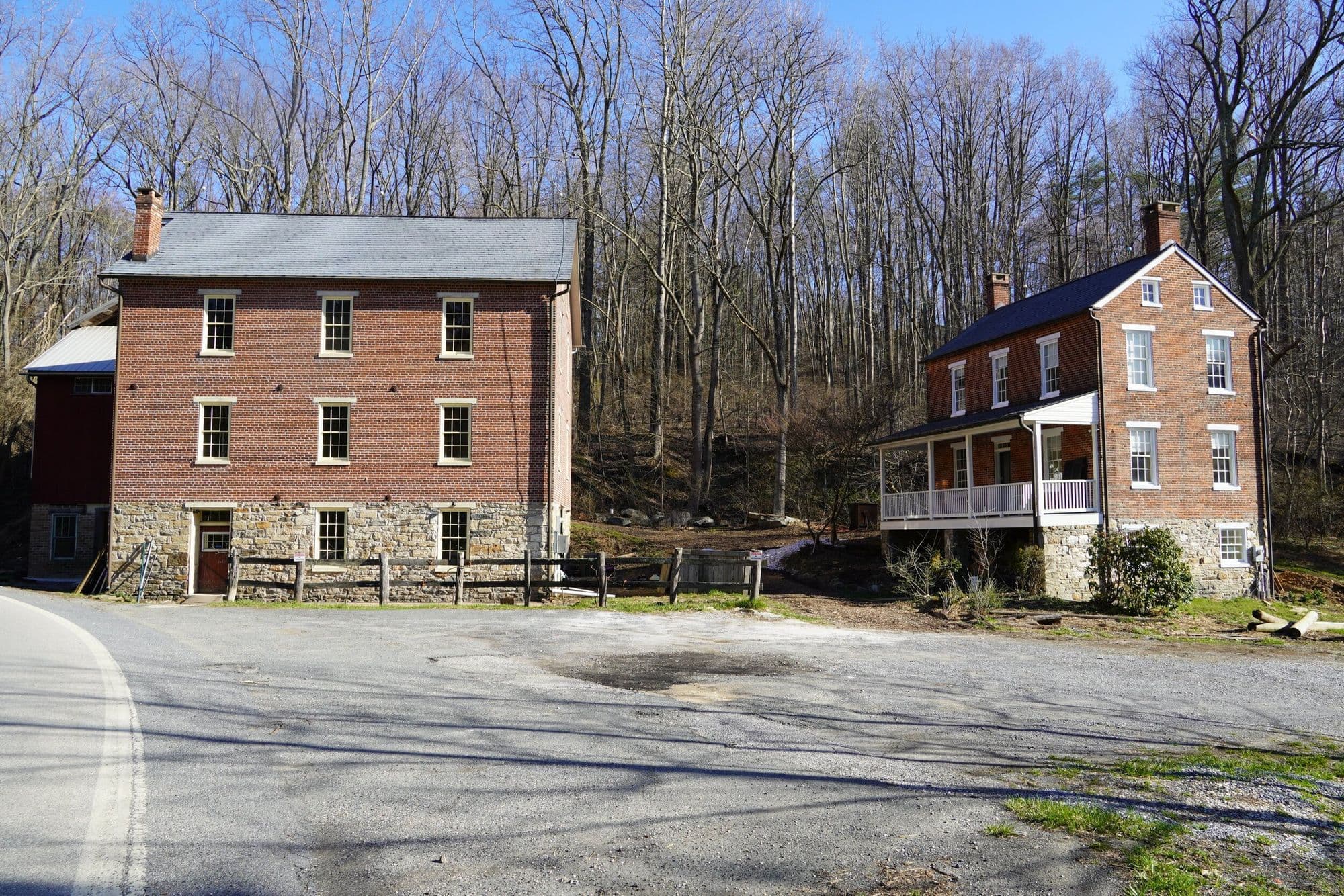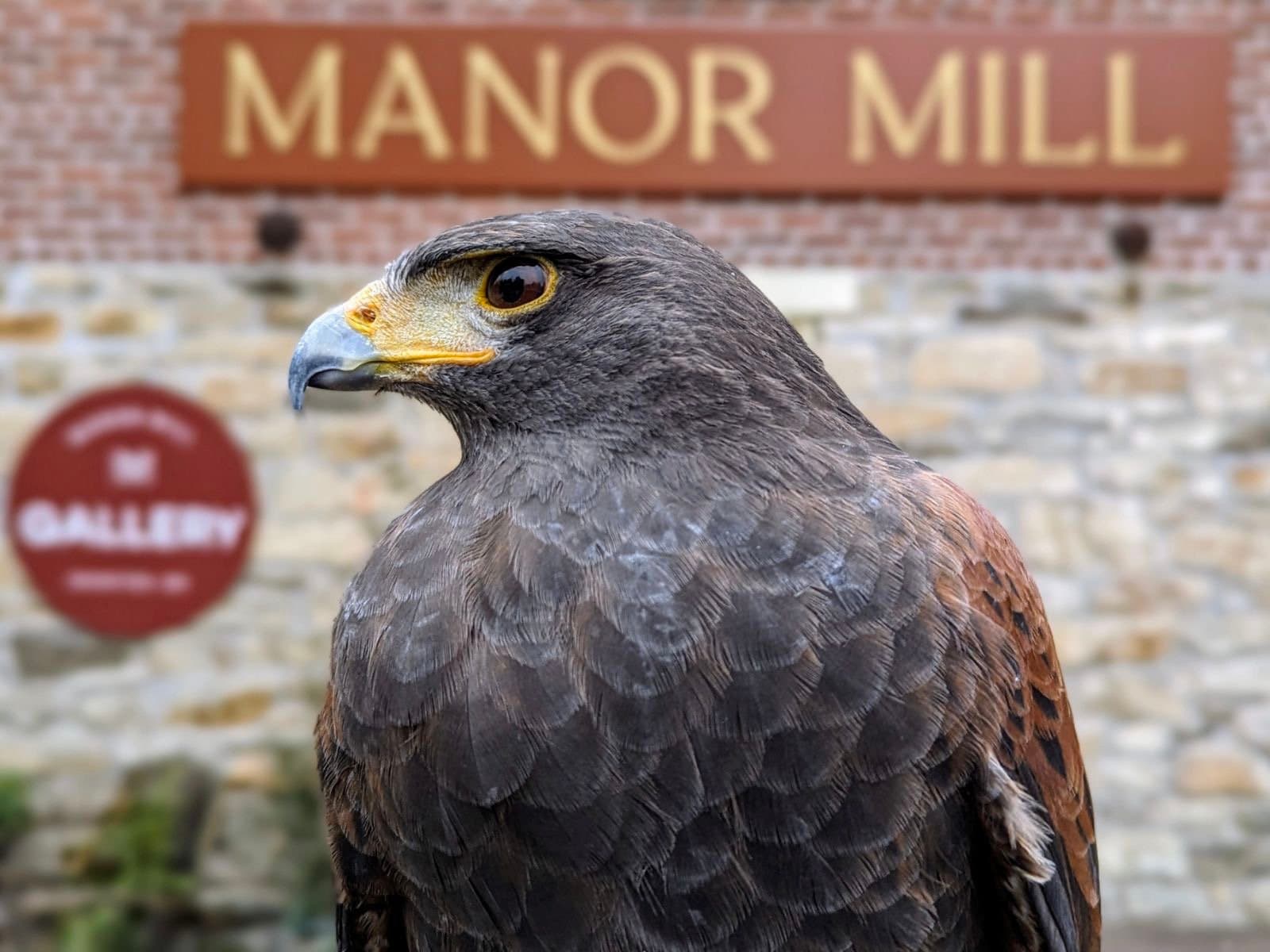
Two mills in Monkton have existed at two different locations. Both mills stood on the same large tract of Bull family property and took different descents after the American Revolution. The last owner of both tracts was the widow of Adam Hoopes, ca. 1771.
Research by Dr. Robert M. N. Crosby at the time of forming a My lady's Manor National Register Historic District demonstrated that the mill now called Manor Mill was the location of the first mill operation in this area and it stood on the Fruitful Valley land grant. In 1742, Thomas Brerewood, owner of the entire manor, had leased Lot 70 to Jacob Bull and required him to build a mill (Deeds TB No. C, folio 121). The second Bull Mill was on present Matthews Road and had a long life as Gwynn's Mill or Baker's Mill, and although shown on the 1915 Bromley atlas, it had been disassembled and its stones reused for road metal by that time.
In 1756, Bull, identified as ‘Old Jacob’, left a water mill and 188 acres to his son Isaac. Isaac Bull in 1769 sold this tract along with his interest in another mill seat to Thomas Harris. Harris deeded in 1770 to Adam Hoopes. Hoopes died the next year, bequeathing the property to his wife Elizabeth Hoopes. Mrs. Hoopes sold to her husband's nephew, Robert Cummins, whose name is often spelled Cummings.
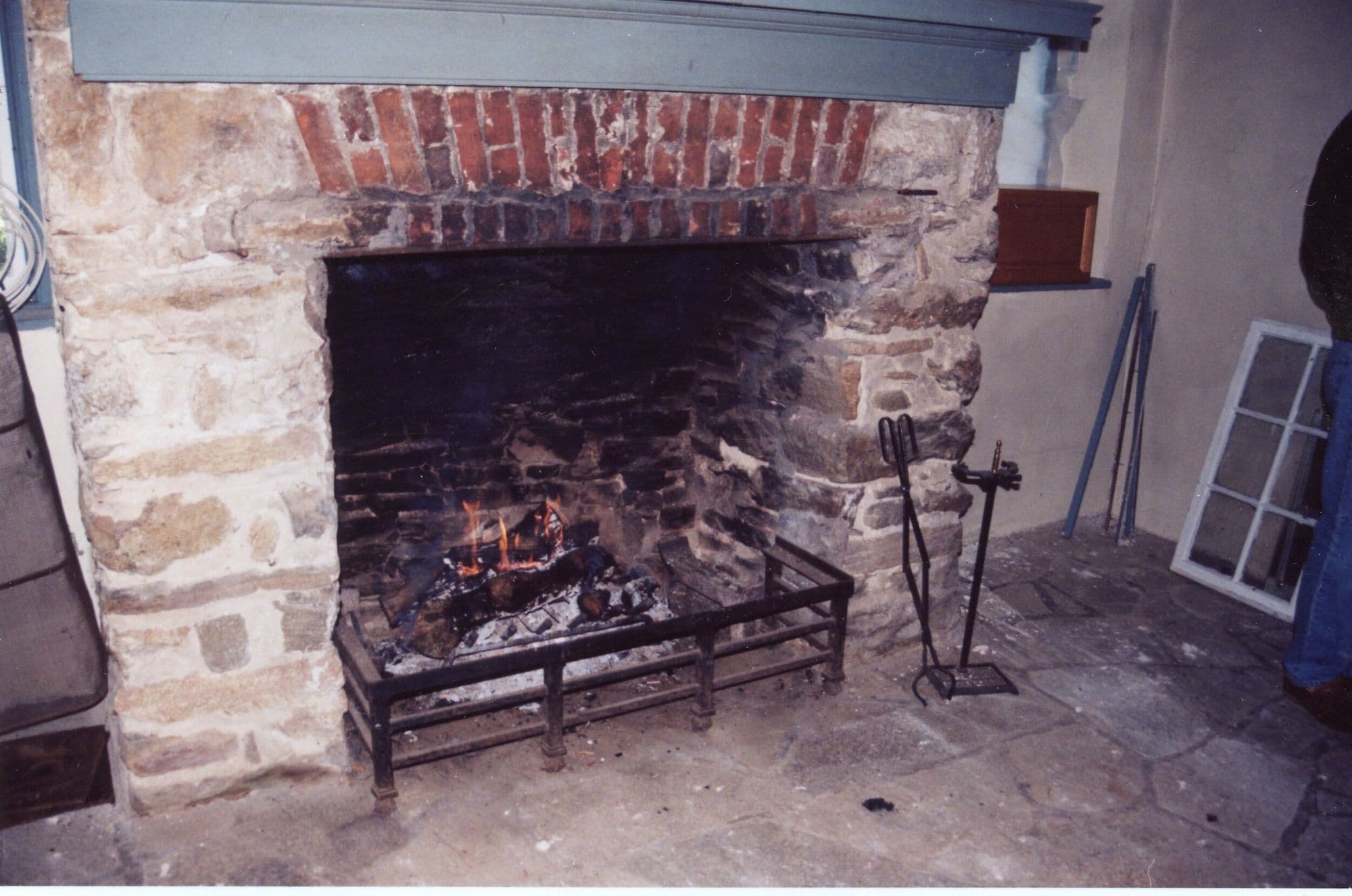
Robert Cummings apparently gave a name to the vicinity and in fact he used the name ‘Monckton Mills’ in a letter written July 19, 1773, recording that he had purchased part of his uncle's estate for 1400 Pounds, Maryland Historical Magazine, 52 (September 1957): 250.
According to one account, the village originally called Charlotte Town, took its present name from the Monkton Mills of William Wynn [sic], who named it for Monkton Priory in Wales. See, ‘Youth Finds Charlotte Town Plan,’ Sun, December 4, 1947. A more supportable theory given in MHM, 52:248, was proposed by Esther Clark Wright, in ‘The Naming of Monkton Mills,’ wherein she stated that the settlement was named by Robert Cummings for Monckton in Nova Scotia. Cummings actually used the name ‘Monckton’ in his 1776 letter to the Council of Safety (Arch. Md., 12:501). Cummins intended to honor Colonel Robert Monckton, son of Viscount John Galloway, the colonel having been involved in dispossessing the French from Nova Scotia. Monkton Mills, without a ‘c’ was a post office name from 1848 to 1883.
Robert Cummins advertised that Thomas Welsh, probably an indentured servant, had run away from his mills on the Great Falls of Gunpowder, Maryland Journal, July 9, 1774. Cummins died at an early age and his mother, Margaret Cummins, served as executrix. In an advertisement about settling the estate, Mrs. Cummins gave her address as ‘Monkton Mills, Baltimore County,’ and urged her son's creditors to come forward, including, ‘Likewise, those who have any demands against the said Cummins, as contractor for victualing the Maryland or Continental troops,’ Dunlap's Maryland Gazette, Baltimore, December 2, 1777.
Margaret Cummings sold some of the estate lands to John Montgomery in 1778, including 122 acres of The Manor, 45 acres of Isaac's Lot, Isaac's Second Lot (23-1/2 acres), and an unnamed parcel of 20 acres (Deeds WG No. B, folio 415). William Gwynn had a survey made, but never patented, for 131 acres called ‘Monkton Mills,’ Unpatented Certificates No. 1039, Maryland State Archives. Dennis Griffith's 1794-1795 State map showed a mill symbol on the west bank of the Gunpowder, which would equate with the Monkton Mill near the ‘Bridge House.’ However, Griffith did not show the first mill on the Charles Run. The 1794 mill symbol marked the site where Isaac Bull had built a mill about 1762 after taking out a writ of ad quod damnum to create a 20-acre mill seat within his own property. He was literally condemning his own land by this process but also creating a salable mill property--a sort of minor subdivision.
In his will, Edward Murray mentioned a mill in his bequest to son Francis Murray (1794). This had to be the predecessor of the present Manor Mill. In rapid order this property passed to Robert Gorsuch (1797), Robert Smith (1797), Gorsuch and Merryman (1799), and finally in 1804 to John Merryman of Benjamin. His purchase included 155 acres, the dwelling plantation, a mill, a cooperage, and ‘the New Mill now being erected at the Falls of Gunpowder.’ Merryman finished the stone building which is the present Manor Mill.
Merryman's enterprises were described in the 1820 Census of Manufactures as ‘two Water Grist Mills, both in Baltimore County, Maryland on the Great Falls of Gunpowder and about one mile apart.’ Merryman's new stone grist mill had two run of stones, bolting cloths, and was worth $6000. It employed one man at $15 per month plus board, ground 9000 bushels of grain per year, and sold at $5 per barrel. The old mill had one run of stones, was worth $2500, and used one man at the same wages. The old mill ground 4800 bushels per year and received the same price of $5 per barrel.
In 1850 the Census of Manufactures, the last to include such detail, showed Samuel Merryman with one employee, with $1500 invested in a custom mill on the Big Gunpowder Falls powered by a water wheel.
Merryman's Branch (deeds JWS 40:504). The Merrymans retained the large brick Federal style or late Georgian house called Fruitful Valley, which is located between the mill and the Hereford Zone. The house was also known as Merryman's Fancy, as that was the name of the resurvey on which it stood.
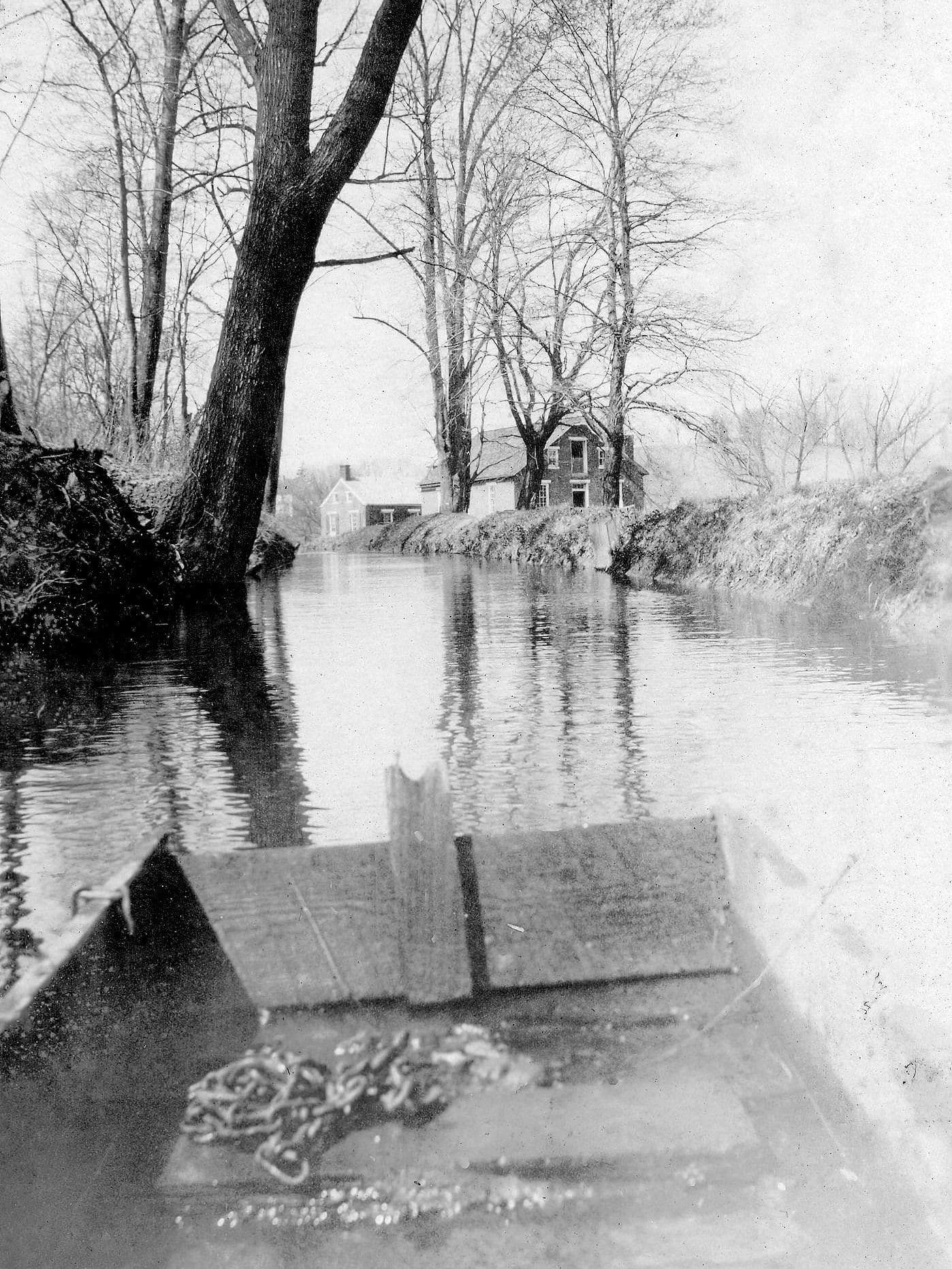
Samuel Miller purchased the manor tract of 152 acres, with the grist mill, the dwelling house, and cooperage, from the Merrymans in 1864 (Deeds GHC 32:293). In the 1870s a terrible storm greatly damaged the area. Charles F. Houck wrote that the disaster destroyed a bridge and caused a man named Schultz to drown. John C. Merryman rebuilt the washed-out bridge. The 1877 Hopkins Atlas showed the manor grist mill was still being operated by Samuel Miller. When Miller died in 1889, the inventory of his estate included several items relating to the mill, such as Flour and Buckwheat and the appurtenances of a grist mill. A miller's account of 1889, found in the papers, showed payments to local farmers for ‘grinding and tollage of grain.’ The flood that year was said to have damaged the gate to the mill race.
John J. Merryman's will included an 1876 plat showing that the mill had left the family. The Merryman children sold 152 acres to Cassandra A. Billingsley in 1897. The Billingsleys sold in 1901 to William W. Miller of York, Pennsylvania.
David M. Schultz came into possession in 1917 and added 26 adjacent acres. An issue of the Jeffersonian in March, 1940, which noted the advanced illness of Mr. Schultz, stated that ‘the mill has been idle now for many years and it is hard to even think that this mill and the neighboring houses were once the center of a thriving community.’ In June, 1941, the Schultzes sold to Francis X. Fahy. In less than a year, Fahy sold to Joseph H. Deute. In 1943 Gourmet magazine featured an article about the Deute's restoration and their life in the mill.
Anna R. Walts acquired the property from Deute in 1947.
In August, 1948, Anna R. Walts conveyed to F. Kenneth Albrecht of Glen Arm, who on May 3, 1948, received a building permit from the County to install plumbing at the mill, suggesting he was now residing there. That same month the Jeffersonian described the reopening of the mill building by Albrecht and noted that residents of the area were ‘glad to see the old mill busy again,’ however the business was evidently not a mill but an antiques dealership.
In 1961, Albrecht's widow conveyed to Asbel O. Fields of Sparks. The Fields family ran an antique business in the mill. To provide room for more antiques on the main floor, a cinder-block wing was built to house the machinery that was on the floor.
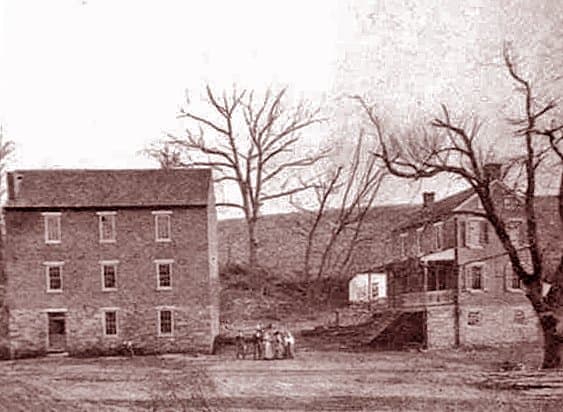
James T. Wollon, Jr., Architect, who wrote the National Register nomination for the Monkton Historic District, provided a professional description of the mill as it appeared in 1978: ‘an imposing, three story stone structure, approximately 35 by 45 feet with two story stone and frame additions (for the most part recent). A frame penthouse over the water wheel is on the south gable end. The gable roof is covered with asphalt shingles. Windows are six-over-six, double hung sash. Entrance is through a frame and glass vestibule on the west (road) side. Interior walls are exposed stone and whitewashed brick...’
In 1977, Rodney O. Fields was interviewed by Mitch Betts about the antique business. In 1978, John McGrain and Mrs. Shirley Clemens were given a tour of the mill by Mrs. Fields. At that time the transfer books in the County Clerk's office recorded the transaction from Murray to Gorsuch, with the notation, ‘the New Mill,’ which helped to prove that the present stone building was new construction, not a remodeled version of an earlier mill.
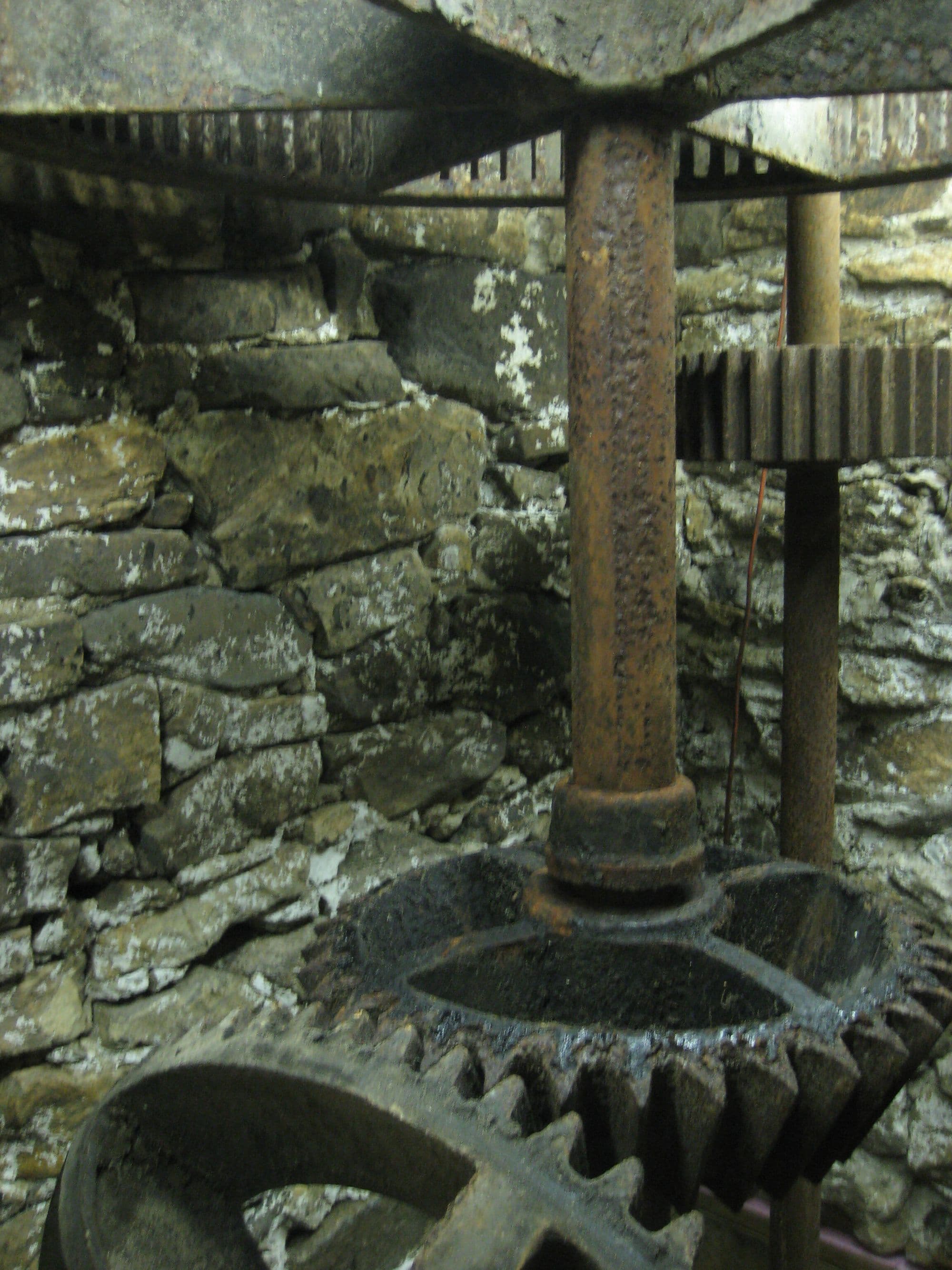
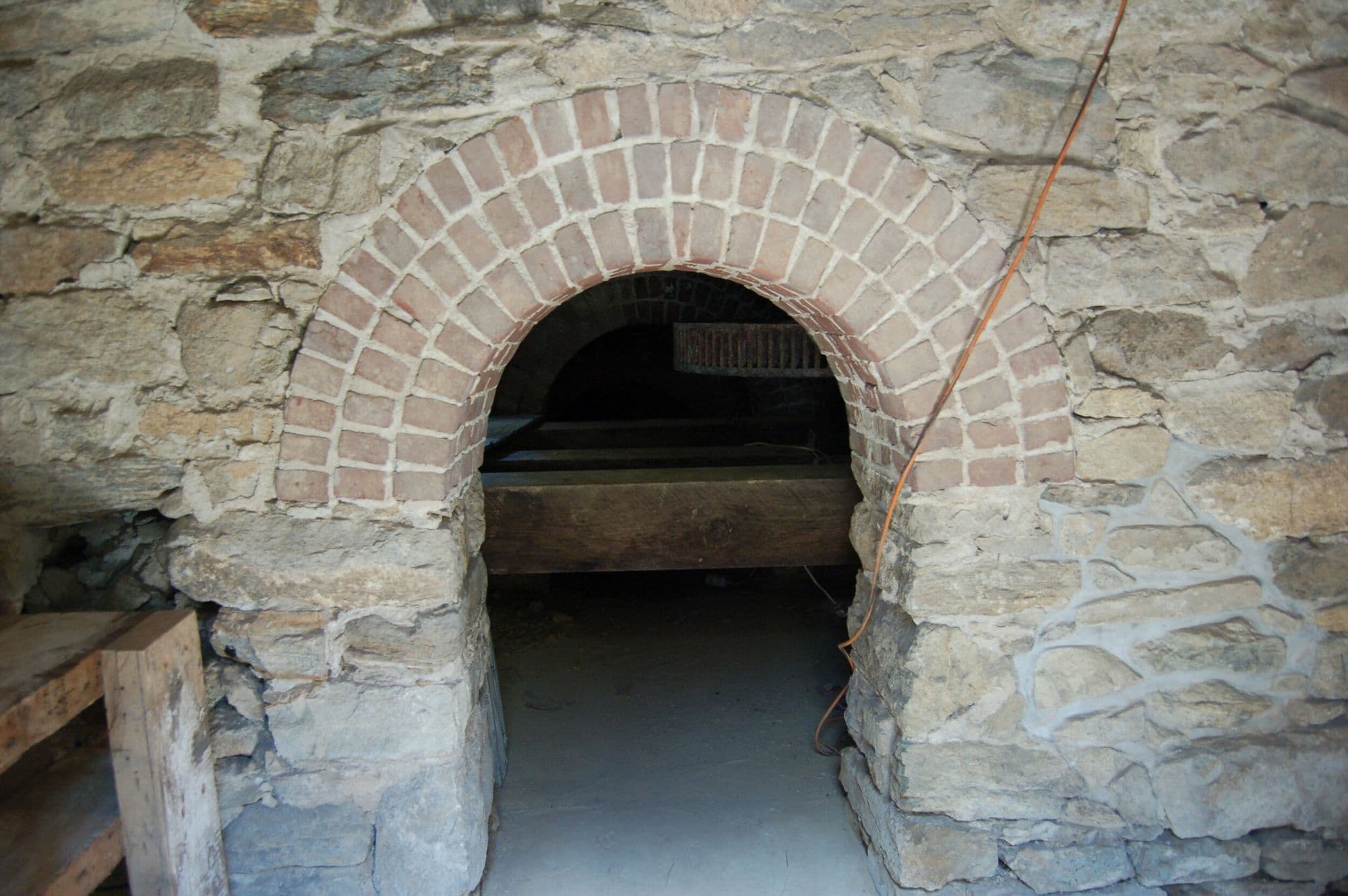
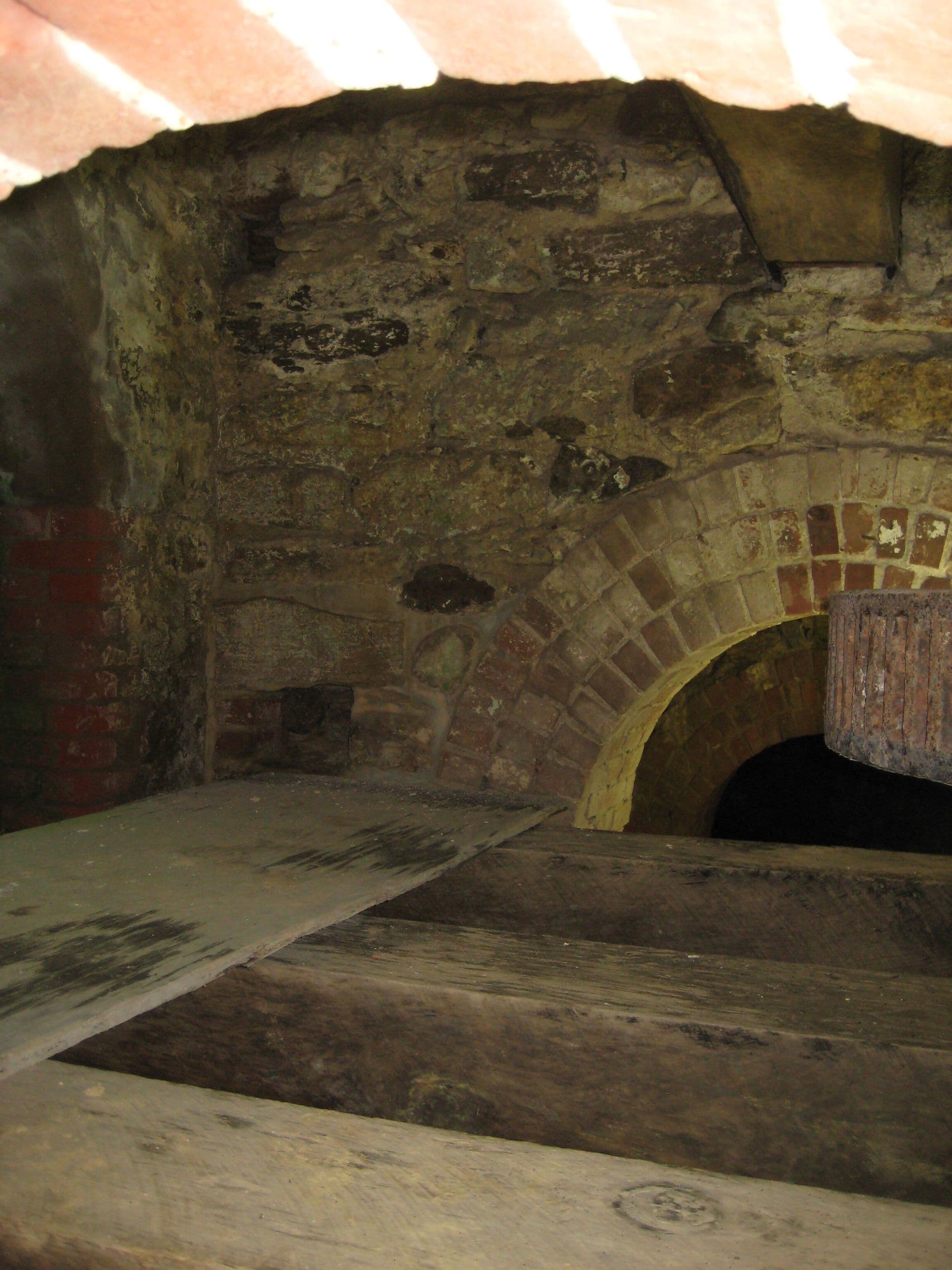
Notes made on the 1978 visit include the statement that there was no sign that roller units were ever adopted here. On the third story one wooden hopper survived. No millstones were left in the interior. The corbeled brick cornice and the window openings with flat arches on the north gable show up well from the parking lot. In the basement, great brick arches spanned the massive space. Here there was a grain-drying kiln, a stone-walled room about 12-by-6 feet containing a flue. Charred wood could be seen in the ash pit. At the period of this kiln it was customary to heat the grain before grinding because the harvest was brought in wetter or damper in earlier times.
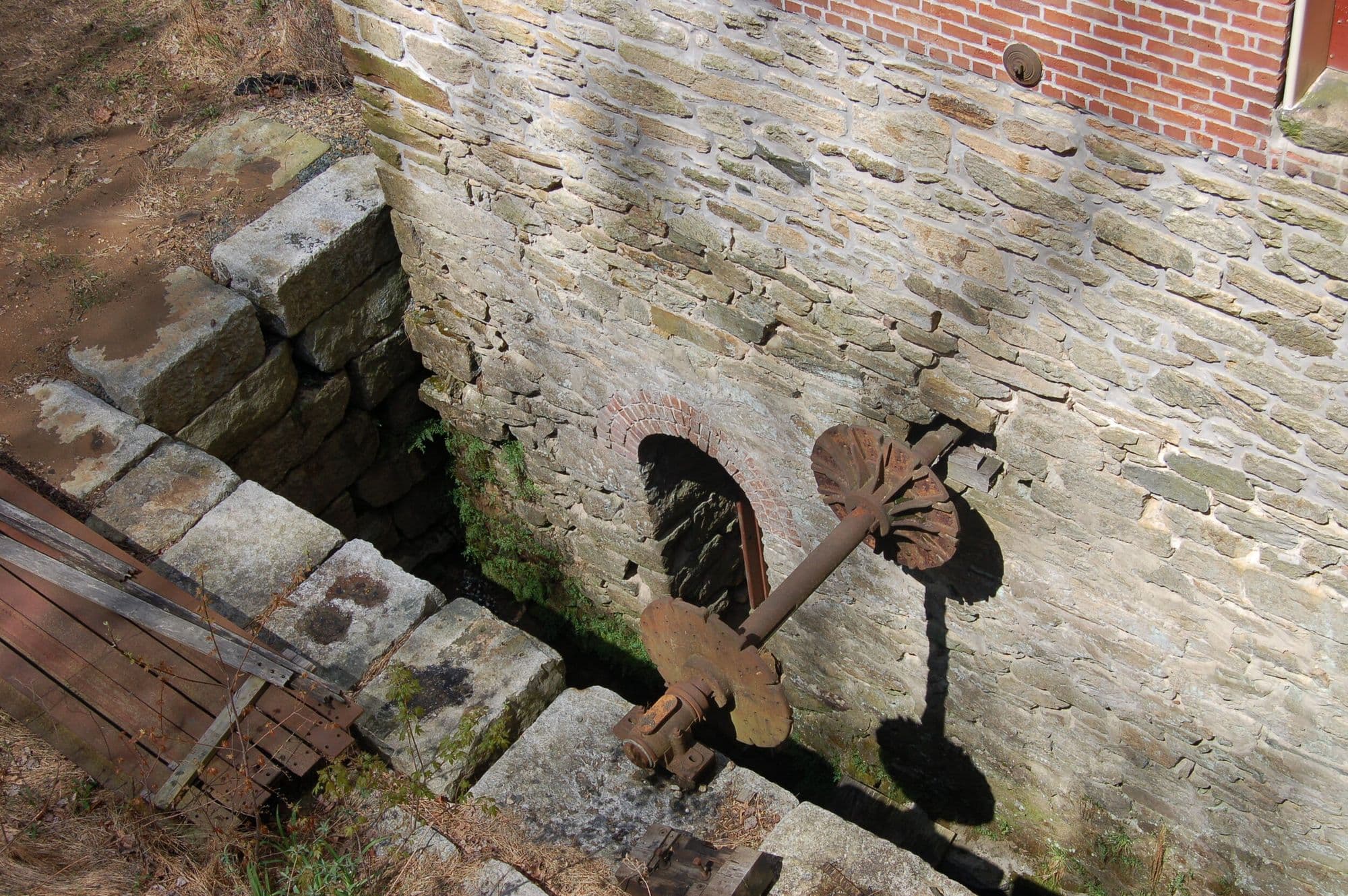
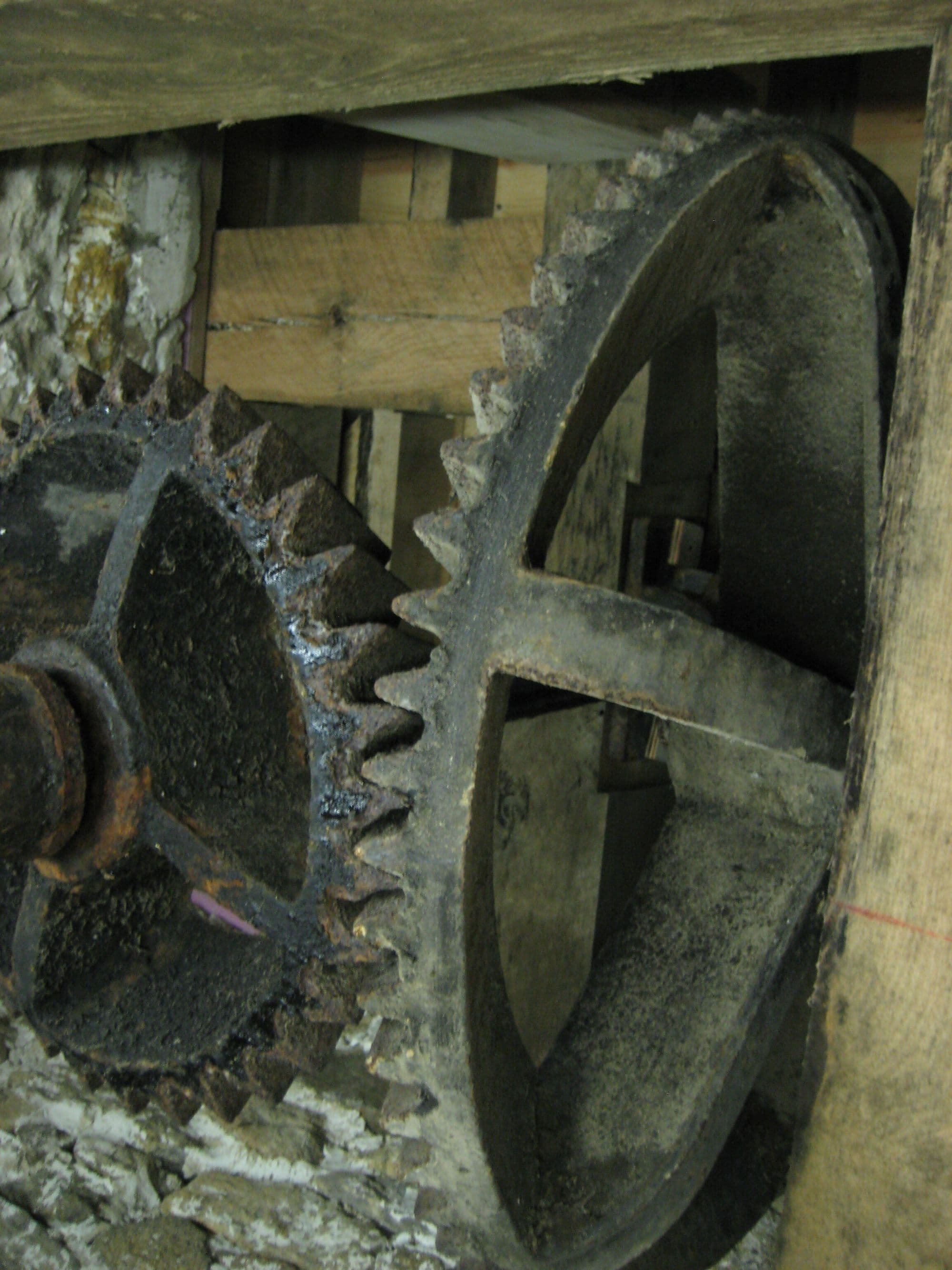
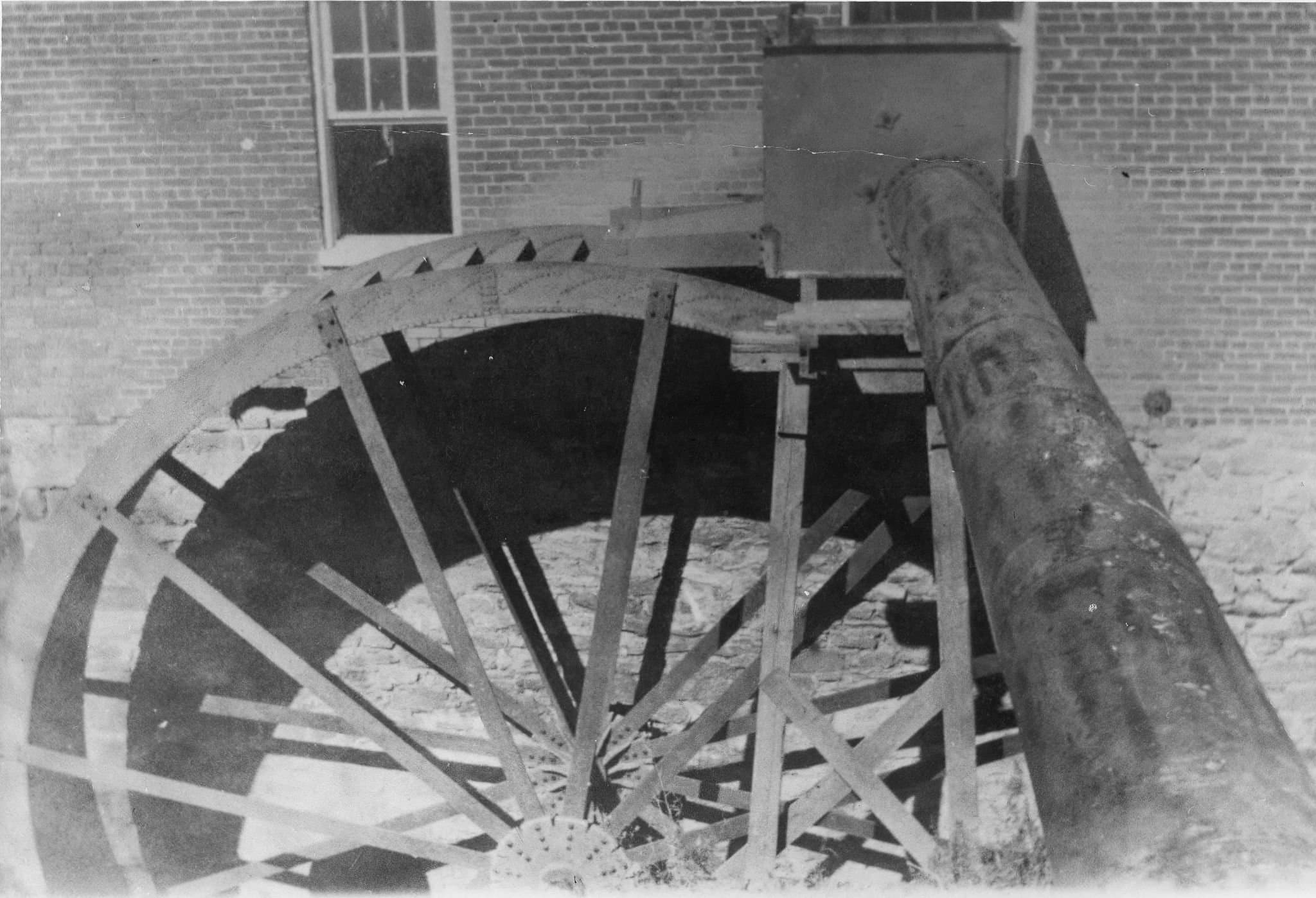
Iron gearing survived in the basement, including a main shaft or spindle, a ring gear driven from the water wheel and a smaller bevel gear, both cast iron with hardwood teeth. The water wheel, about 32 feet in diameter (it was not possible to get a completely accurate measurement) of the overshot type. It sat in a stone-walled wheel pit so deep that it required the equivalent of a three-story penthouse or housing to shelter it.
In the yard, millstones were on display, both French burr stone and a lighter conglomerate stone of local origin.
At that visit, before finding the Transfer Book entry, the dating of the building remained problematic. Any earlier wooden mills, if they existed on this site, left no trace in the present building. About 1800 seems a reasonable estimate. An elevator system was later noted, with five heads or wheels surviving on upper floors. The heads were wooden with small metal cups. The chutes for elevating grain were about 6 by 9 inches, indicating that the elevator system was added at a later date. The millstone dimensions were irregular; at least one was about 45 inches across. The runner stones had an ‘eye’ shape resembling a Red Cross symbol.
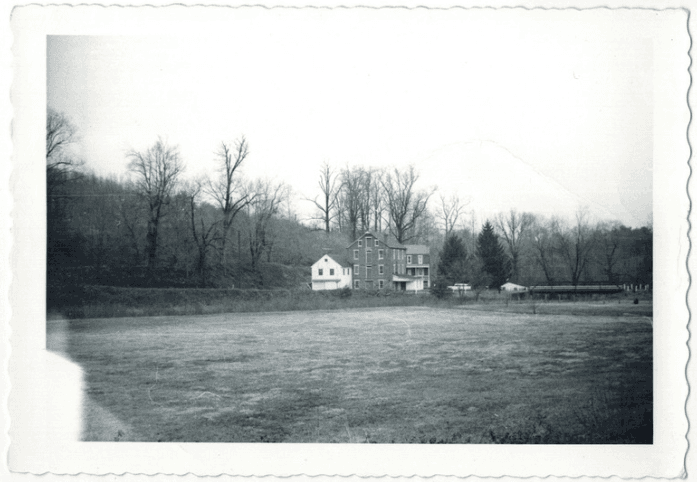
Rodney Fields continued the antique business until 2004. That year, Curtis and Joann Shearer bought the mill property and promptly started restoring the brick dwelling. The mill had suffered serious alterations since 1978, and there was much seepage from the roof. The floors in places were wearing thin. The water wheel buckets had entirely rusted away. The wooden grain hoppers from the old millstone installations were still on hand. The excellent crafting of chamfered posts was still apparent.
Mr. Shearer founded Millstone Cellars, which became a successful artisanal cidery business for approximately 10 years, using apples from local orchards in Maryland and Pennsylvania and produced onsite. The business closed in 2017 and the property began to fall into disarray as it was abandoned. Its current owner has continued the restoration of both the house and mill starting in November, 2019.